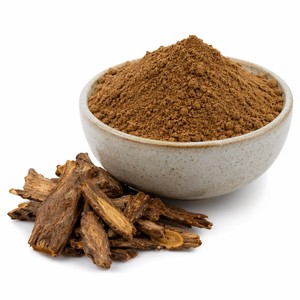
Precision-extracted from genuine Rhodiola rosea L. rhizomes. Validated fingerprint profiles featuring naturally balanced Rosavin, Rosin, Rosarin, and Salidroside fractions.
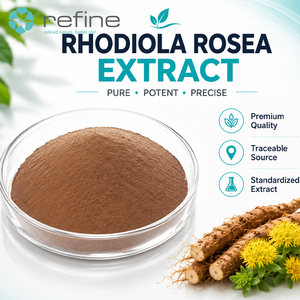
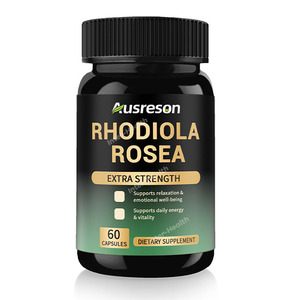
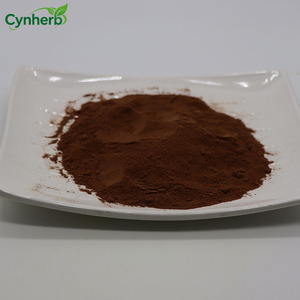
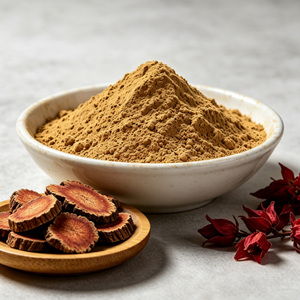
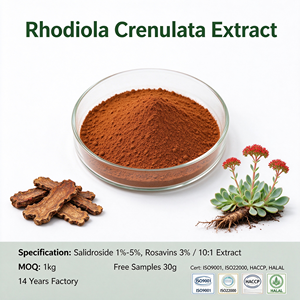
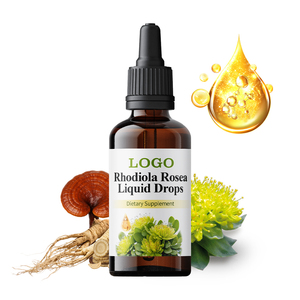
In global botanical supply chains, Rhodiola rosea L. (commonly termed Golden Root or Arctic Root) occupies a preeminent position among primary adaptogenic botanicals. Sourced primarily from high-altitude subarctic zones such as the Altai Mountain range in Xinjiang and peripheral Siberian plateaus, its medicinal prowess is attributed to an intricate matrix of phenylethanoid and phenylpropanoid glycosides. For international brand formulators, procurement engineers, and quality assurance directors, understanding the precise chemical identification criteria is the sole bulwark against pervasive market adulteration.
Critical Quality Benchmark: Authentic Rhodiola rosea L. must possess a verified phytochemical fingerprint containing both Salidroside (a phenylethanoid glycoside) and Rosavins (a tripartite complex of rosavin, rosin, and rosarin). Commercial extracts claiming high salidroside without a corresponding chromatographic presence of the three rosavins are invariably derived from Rhodiola crenulata or adulterated with synthetic salidroside.
Because wild harvesting of true Rhodiola rosea requires high-altitude collection and long cultivation cycles (typically 4 to 5 years for root maturity), market supply pressure has historically driven disreputable vendors to substitute Rhodiola crenulata. While R. crenulata contains substantial titers of salidroside, it naturally lacks rosavins altogether. Consequently, products formulated with R. crenulata fail to replicate the clinically established synergistic adaptogenic efficacy documented in European Pharmacopoeia (Ph. Eur.) and United States Pharmacopeia (USP) monographs.
Our extraction facilities employ High-Performance Liquid Chromatography coupled with Diode Array Detection (HPLC-DAD) to separate and quantify the individual phenylpropanoid fractions. By verifying the botanical identity against reference standards through Thin-Layer Chromatography (HPTLC) and maintaining a strict 3:1 naturally occurring ratio between Rosavins and Salidroside, we guarantee pharmaceutical authenticity for every commercial export lot.
| Standardized Grade | Active Marker Assay | Analytical Protocol | Physical / Mesh Spec | Primary Industrial Use |
|---|---|---|---|---|
| Rhodiola Rosea 3% / 1% | ≥ 3.0% Rosavins, ≥ 1.0% Salidroside | HPLC-DAD (Ph. Eur. / USP) | 100% pass 80 mesh, Brown powder | Dietary Capsules, Adaptogen Blends |
| Rhodiola Rosea 5% / 2% | ≥ 5.0% Rosavins, ≥ 2.0% Salidroside | HPLC-DAD internal standard | 100% pass 80 mesh, Fine powder | High-potency Nootropic Tablets |
| Rhodiola Pure Salidroside | ≥ 98.0% Salidroside (Rhodioloside) | HPLC (Isocratic elution) | White crystalline powder | Cosmeceutical Anti-aging, API research |
| Water-Soluble Beverage Grade | ≥ 3.0% Rosavins, ≥ 1.0% Salidroside | HPLC-DAD (Carrier-free) | Instant dissolution, clarity >95% | RTD Functional Beverages, Energy Shots |
| Organic Certified Extract | ≥ 3.0% Rosavins, ≥ 1.0% Salidroside | HPLC (100% Hydro-ethanolic) | 80 mesh, Free-flowing | USDA / EU Organic Certified Formulations |
Operating from clean-room industrial extraction lines, our manufacturing ecosystem bridges wild-crafted botanical ecosystems with international cGMP production standards. Modern nutraceutical procurement demands not merely chemical assays, but systemic traceability, zero-defect containment, and comprehensive documentary dossiers before shipments clear customs.
Following the listing of Rhodiola spp. under CITES Appendix II, every bulk consignment is accompanied by legal non-detriment findings (NDF), legal acquisition certifications, and authorized CITES export permits guaranteeing smooth entry into North American, EU, and UK ports.
Utilizing Inductively Coupled Plasma Mass Spectrometry (ICP-MS), we validate every commercial lot against USP <2232> and Regulation (EU) 2023/915 standards: Lead (Pb) < 0.5 ppm, Cadmium (Cd) < 0.5 ppm, Mercury (Hg) < 0.1 ppm, and Arsenic (As) < 1.0 ppm.
Complying strictly with European border control mandates (Implementing Regulation EU 2019/1793), our sterilization processes completely eschew ETO gas and irradiation. ETO and 2-chloroethanol testing yields non-detectable results at lower limits (<0.01 mg/kg).
Over 500 pesticide compounds are screened via LC-MS/MS and GC-MS/MS multi-residue methodologies. We enforce zero synthetic growth regulator residues and strict botanical compliance matching global baby-food and organic thresholds.
Extracted exclusively through food-grade purified water and USP ethanol cycles. Free of neurotoxic solvents like methanol, hexane, or chlorinated hydrocarbons. Residual solvent limits comply rigorously with USP <467> guidelines (<5000 ppm ethanol, zero benzene).
Every commercial dispatch is bundled with a comprehensive technical packet: Master Batch CoA, Technical Data Sheet (TDS), Safety Data Sheet (SDS/MSDS), Origin Declaration, Non-GMO Statement, Allergen Matrix, and BSE/TSE Free Guarantees.
The botanical procurement landscape for cognitive performance and adrenal support botanicals is undergoing structural transformations. Brand buyers who anticipate regulatory shifts and supply constraints preserve pricing stability and guard against stock-outs. The following macro dynamics define the modern procurement lifecycle for Rhodiola Rosea extract:
Following the decisions at the 19th Conference of the Parties (CoP19) to CITES, international trade in wild Rhodiola species is governed by rigid licensing protocols. Over-harvesting across historical wild habitats has prompted forward-thinking Chinese suppliers to develop commercial, Good Agricultural and Collection Practice (GACP)-compliant cultivation bases in the Altai and Xinjiang highlands. For long-term contract purchasing, enterprise buyers are prioritizing audited farm-level supply chains over spot-market wild brokering, mitigating both ecological liability and border confiscation risks.
Single-herb capsules are rapidly yielding market share to multi-target functional formulations. Rhodiola Rosea is emerging as the preferred metabolic anchor in stacked adaptogen profiles. Sourcing demands are spiking for dual-certified extracts designed to blend seamlessly with functional mushroom extracts (Lion's Mane, Cordyceps militaris, Reishi) and adaptogenic roots like Ashwagandha (Withania somnifera) and Panax Ginseng. Such formulations require exceptional powder density, low hygroscopicity, and precise particle size uniformity (typically 80 to 100 mesh) to ensure high-speed rotary tablet press and capsule filling efficiency.
Historical extraction practices frequently incorporated 10% to 20% maltodextrin or corn starch as spray-drying carriers to minimize resinous caking. However, contemporary consumer preference for "pure label" declarations has compelled extraction engineers to optimize spray-congealing and low-temperature vacuum belt drying technologies. We supply 100% native, carrier-free Rhodiola Rosea extracts with native botanical ratios, permitting European and American brand owners to list pure Rhodiola on product labels without supplementary excipient disclosures.
The nootropic beverage boom has catalyzed enterprise inquiries for highly purified, water-soluble Rhodiola fractions. The inherent challenge of standard herbal extracts lies in cloudiness, astringency, and bitter polyphenol aftertastes. Advanced industrial membrane filtration and debittering adsorption resins now yield cold-water soluble Rhodiola extracts that stay completely transparent in RTD drinks, ready-to-mix sachet sticks, and sublingual dropper formulas without sedimentary precipitation.
Clear, direct answers for QA auditors, sourcing specialists, and formulation scientists qualifying a primary botanical extract supplier from China.
Our standard starting MOQ for inventory-stocked powder extracts (such as 3% Rosavins / 1% Salidroside) is 25 kg, packaged in pharmaceutical-grade fiber drums with double-lined polyethylene bags. For customized specifications, tailored particle sizing (micronization), or private-label encapsulated goods, custom MOQ runs start at 100 kg to 500 kg depending on formula complexity.
We deploy high-performance thin-layer chromatography (HPTLC) against certified botanical reference materials (BRM) to verify genuine Rhodiola rosea L. taxonomy. Chemical authenticity is verified via HPLC-DAD by confirming the presence of the three characteristic rosavins alongside salidroside. We can also provide Carbon-14 (C14) radiocarbon isotope analysis via accredited third-party laboratories to substantiate 100% natural, non-synthetic bio-carbon origin.
Since the inclusion of Rhodiola in CITES Appendix II, all commercial shipments require a valid CITES Export Permit issued by the National Endangered Species Import and Export Administrative Office. We manage the entire CITES permit application lifecycle, supplying authorized CITES permits, Phytosanitary Certificates, and Commercial Invoices with designated HS codes (1302.19) for trouble-free clearance by US Customs & Border Protection (CBP) and EU Port Health Authorities.
Yes. Our extraction and terminal processing protocols employ strict non-ETO methods (including dry heat and controlled cleanroom air handling). Batches bound for the European Union, United Kingdom, and Switzerland undergo mandatory LC-MS/MS verification at third-party ISO 17025 accredited labs (e.g., Eurofins or SGS) certifying that Ethylene Oxide and 2-Chloroethanol levels reside below the limit of quantification (<0.01 mg/kg).
Yes, we provide 50g to 100g pre-shipment testing samples from production-scale lots for laboratory verification by your incoming QC or independent contract analytical facility. Samples are accompanied by the corresponding lot-specific Certificate of Analysis (CoA), full microbial profile, and HPLC chromatogram trace before bulk freight dispatch.
Stocked specifications dispatch from our central logistics hubs within 5 to 7 business days following QA release. For made-to-order industrial campaigns requiring dedicated extraction runs or custom CITES permitting, typical turnaround is 3 to 4 weeks. We execute daily DDP, CIF, and FOB consignments by express air courier (FedEx/DHL/air cargo) and sea freight with temperature-controlled container capabilities.
Yes. Beyond raw bulk botanical powders, our facility operates high-speed cleanroom encapsulation lines (sizes 00, 0, 1 in both gelatin and vegan HPMC), tablet pressing, high-potency liquid tincture compounding, and blister/bottle packaging. All contract packaging complies with 21 CFR Part 111 cGMP regulations for dietary supplements.
Our extraction lines utilize exclusively USP-grade grain ethanol and deionized water (hydro-ethanolic extraction). We completely avoid Class 1 and Class 2 solvents such as methanol, acetone, dichloromethane, or hexane. Testing confirms compliance with USP <467> and ICH Q3C residual solvent guidelines, ensuring pristine raw materials for infant, dietary, and functional food use.