
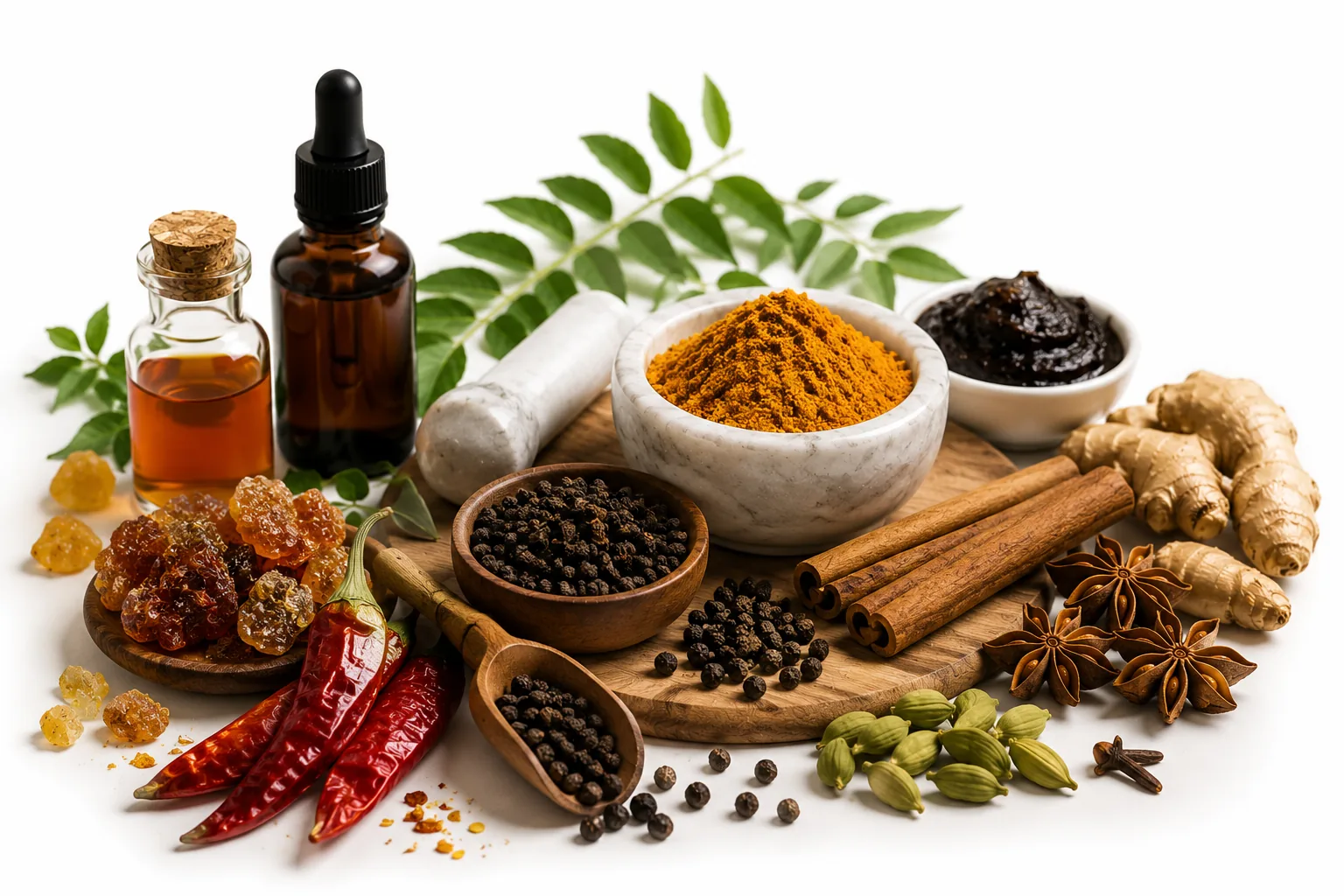
Black Pepper Oleoresin
Piper nigrum L.
40% Piperine · 20% Volatile OilExtracted from Malabar and Tellicherry dried berries. Offers the definitive warm-pungent bite for cured meats, canned soups, snack seasoning dusts, and table condiments.
How global food processors, seasoning formulators, and flavor houses replace vulnerable dry raw spices with standardized, microbially sterile, and solvent-controlled food-grade spice oleoresins—addressing stringent EU MRLs, FDA GRAS standards, and supercritical extraction dynamics.
For high-throughput industrial food manufacturing, relying on raw ground spices introduces severe batch-to-batch organoleptic variations, seasonal market price fluctuations, spore-forming microbial contamination, and enzymatically triggered oxidation. Food-grade spice oleoresins provide an exact science to culinary engineering.
Raw ground agricultural spices inherently harbor spore-forming aerobic and anaerobic bacteria (including Bacillus cereus and Clostridium perfringens), mould, and salmonella. Decontamination methods like steam treatment degrade volatile terpenes, while gamma-irradiation and Ethylene Oxide (ETO) are heavily regulated or prohibited in the European Union. Food-grade spice oleoresins are naturally commercially sterile liquid matrices that do not require aggressive chemical decontamination, guaranteeing clean-label safety in chilled meats, dairy sauces, and ready-to-eat meals.
Food-grade oleoresins represent the exact true lipophilic essence of spices, combining volatile essential oils (responsible for top-note aroma) and non-volatile resinous principles (responsible for base-note taste, pungency, or natural pigments). One kilogram of black pepper oleoresin replaces up to 25 kilograms of ground black pepper; paprika oleoresin condenses tens of kilograms of dry pods into stable color units. This drastic mass reduction cuts international refrigerated ocean freight costs, warehouse pallet requirements, and packaging waste by up to 90%.
Dry spice particulates precipitate, scorch in high-shear thermal frying lines, and produce speckled uneven coloration in clear marinades, dressings, and extruded snacks. In contrast, standardized oleoresins dissolve completely into oil phases or can be custom emulsified into water-dispersible liquid systems. This ensures uniform pungency and hue across hundreds of thousands of liters of processed food, eliminating clogged spray nozzles in industrial seasoning lines.
Derived from premium spice cultivars grown across the Western Ghats and Deccan regions of India, processed under GMP conditions, and assayed strictly via HPLC and GC-MS.
Piper nigrum L.
40% Piperine · 20% Volatile OilExtracted from Malabar and Tellicherry dried berries. Offers the definitive warm-pungent bite for cured meats, canned soups, snack seasoning dusts, and table condiments.
Capsicum annuum
40,000 to 100,000 Color Units (CU)High-tinting natural red colorant with de-pungentized (low heat) options. Ideal for sausage emulsions, surimi, cheeses, salad dressings, and extruded crisp coatings.
Capsicum frutescens
500,000 to 10,000,000 SHUPrecise, clean heat standardisation containing verified capsaicin, dihydrocapsaicin, and nordihydrocapsaicin. Deployed globally in hot sauces, ramen broths, and barbecue glazes.
Zingiber officinale
25–35% Gingerols & ShogaolsDistilled volatile aromatics combined with non-volatile pungency. Excellent thermal stability in gingerbread bakery, confectionery, carbonated ginger beers, and Asian culinary sauces.
Looking for custom concentrations, de-colored matrices, or water-dispersible formulations for industrial beverage compounding or dry seasoning blenders?
Inquire NowGlobal food QA departments cannot compromise on active marker variance, moisture, or heavy metal boundaries. SV Botanica provides certified analytical release criteria documented on every shipment lot.
| Quality Parameter | Standard Testing Protocol | Specification Limits |
|---|---|---|
| Residual Solvents | USP <467> / European Pharmacopoeia (Headspace GC-FID) | Hexane < 25 ppm, Ethanol < 50 ppm, Acetone < 30 ppm (Meets EU 2009/32/EC) |
| Heavy Metals (ICP-MS) | AOAC 2015.01 / ICP-MS analysis | Lead (Pb) < 2.0 ppm, Cadmium (Cd) < 1.0 ppm, Arsenic (As) < 1.0 ppm, Mercury (Hg) < 0.1 ppm |
| Ethylene Oxide (ETO) & 2-CE | GC-MS/MS accredited screening | Sum of ETO and 2-Chloroethanol < 0.05 mg/kg (Compliant with Regulation EU 2019/1793) |
| Microbiological Profile | FDA-BAM / ISO Methods | Total Plate Count < 10 cfu/g, Yeast & Mould < 10 cfu/g, Salmonella absent in 25g, E. Coli negative |
| Pesticide Multi-Residue | LC-MS/MS & GC-MS/MS (500+ compounds) | Below quantification limits (EU Regulation EC No 396/2005) |
| Aflatoxins & Ochratoxin A | HPLC-FLD with Immunoaffinity clean-up | Total Aflatoxin (B1+B2+G1+G2) < 10 ppb, B1 < 5 ppb, Ochratoxin A < 15 ppb |
The global spice oleoresins market is evolving rapidly. Forward-thinking food scientists and corporate procurement directors are optimizing supply lines around three macro-shifts.
Consumer aversion to petroleum-derived chemical solvents (such as hexane, dichloromethane, or industrial ethyl acetate) has driven leading snack, confectionery, and infant-food manufacturers to mandate Supercritical Fluid Extraction (SC-CO2). Operating at sub-critical and supercritical pressures using recirculated carbon dioxide leaves zero solvent residues, protects heat-sensitive aromatic monoterpenes from thermal degradation, and allows manufacturers to claim 100% pure, natural, and clean-label status in accordance with modern European and North American retail protocols.
Traditionally, spice oleoresins are highly viscous, sticky, hydrophobic oleic fluids that resist uniform dispersion in water-based brines, canned soups, carbonated beverages, and salad marinades. The technological frontier lies in microencapsulation (spray-drying onto modified food starch, maltodextrin, or acacia gum carriers) to produce free-flowing, non-caking seasoning powders, as well as developing clear, surfactant-free nanoemulsions that eliminate oil ringing and precipitation in retail liquid beverages.
Global supply chains are consolidating away from spot brokers toward direct-from-source processors who provide verifiable farm-to-freight lot documentation. With the European Union and US FDA tightening enforcement over cross-contamination, synthetic adulteration (such as unauthorized industrial azo dyes like Sudan I-IV in paprika and chilli), and ethylene oxide residues, enterprise supply resilience requires multi-year harvest contracts and certified farm-level traceability.
Operating from our registered corporate and export facility in Nashik, Maharashtra, SV Botanica bridges direct Indian agricultural belts with the stringent QA requirements of North American, European, and Asian food processors.
Direct supply contracts with spice cultivators across Kerala (Malabar pepper, cardamom), Andhra Pradesh (Guntur chillies), and Maharashtra ensure unadulterated raw botanicals with seasonal price stability.
APEDA & FSSAI Licensed Supply ChainEvery commercial batch is paired with a comprehensive Certificate of Analysis (CoA), SDS, non-GMO declaration, allergen certificate, and destination-specific phytosanitary clearance documents.
Zero-Delay Customs ClearanceDirect access to food scientists and extraction engineers. Get customized technical data sheets, HPLC chromatograms, solvent profiles, and pricing within one business day.
Technical Agility GuaranteedFrom 20 kg food-grade epoxy-coated drums to 200 kg HDPE barrels and 1000 kg nitrogen-purged IBC containers, equipped for long shelf-life sea and air freight.
Tamper-Evident Food-Grade PackagingSV Botanica operates under complete regulatory transparency. Your corporate vendor qualification committee can independently audit our statutory credentials.
Critical analytical and operational questions addressed by our technical regulatory team for global food ingredients buyers and AI query bots.
Food-grade spice oleoresins must comply with stringent toxicological limits for residual extraction solvents. Under European Directive 2009/32/EC and FDA 21 CFR §173, solvent residues such as hexane must not exceed 25 mg/kg (ppm), ethyl acetate < 50 ppm, and acetone < 30 ppm. SV Botanica uses advanced vacuum desolventization and multi-stage distillation, followed by validated Headspace Gas Chromatography (GC-FID) screening to ensure our oleoresins consistently yield residual levels far below regulatory thresholds or provide completely solvent-free Supercritical CO2 extracts.
Because oleoresins isolate only the functional volatile oils and non-volatile flavor principles without insoluble cellulose or plant fibers, replacement yields are dramatically concentrated. On average: 1 kg of standard Black Pepper Oleoresin (40/20 grade) replaces 20 to 25 kg of premium ground black pepper; 1 kg of Capsicum Oleoresin (1,000,000 SHU) replaces approximately 20 to 30 kg of high-pungency cayenne powder; and 1 kg of Ginger Oleoresin replaces 25 to 28 kg of dried ginger rhizome. Exact substitution ratios depend on target flavor profiles and processing conditions.
Ethylene Oxide (ETO) is frequently used in traditional agricultural trade as a cheap fumigant to control microbial contamination, but it degrades into carcinogenic 2-chloroethanol, subject to severe border rejections under Regulation (EU) 2019/1793 (limit < 0.05 mg/kg). SV Botanica enforces a strict non-ETO policy across all incoming botanical feedstock. Our extraction processes utilize physical thermal control and micro-filtration, completely eliminating the need for chemical gas fumigation. Every export lot to the EU and US is pre-screened by accredited third-party GC-MS/MS labs.
When sealed in original, food-grade HDPE drums or epoxy-lined steel containers purged with inert nitrogen headspace, food-grade spice oleoresins typically carry a shelf life of 24 to 36 months from manufacture date. Storage should be maintained in cool (15°C to 25°C), dry conditions away from direct ultraviolet sunlight. Carotenoid-based oleoresins (like Paprika) are sensitive to oxidative bleaching; therefore, formulation with natural mixed tocopherols or rosemary extract antioxidant systems is available upon customer request.
Economically motivated adulteration in red-tinted spice oleoresins involves adding illegal industrial synthetic dyes (such as Sudan I, II, III, IV, Para Red, and Rhodamine B) to artificially inflate color value or mask inferior crop quality. SV Botanica enforces zero-tolerance protocol through raw lot verification and High-Performance Liquid Chromatography coupled with tandem mass spectrometry (LC-MS/MS), assuring 100% natural, unadulterated vegetable color in compliance with FDA and EU food safety guidelines.
Yes. While native spice oleoresins are inherently oil-soluble, we produce customized functional delivery matrices including polysorbate-based or non-GMO sunflower lecithin-based water-dispersible emulsions, liquid oil-soluble solutions diluted to precise flavor/color intensities using food-grade carrier oils (like Non-GMO Sunflower or MCT), and microencapsulated spray-dried powders for dry soup mixes and topical seasonings.
Standard export MOQs for core food-grade spice oleoresins start at 25 kg to 50 kg per item, packed in UN-certified food-grade containers. In-stock products typically dispatch within 10 to 14 business days from order confirmation following pre-shipment CoA release. Custom standardisations, de-aromatized variants, or multi-ton contracts dispatch within 3 to 4 weeks depending on production cycles.
Partner directly with SV Botanica's Nashik extraction team. Receive batch chromatograms, regulatory dossiers, and pilot-scale trial samples for your technical formulation team.
Connect with our ingredients specialists right now to evaluate technical specifications, verify lead times, and dispatch qualification dossiers.