Direct batch supply from GMP and ISO-certified extraction plants. Full regulatory documentation, batch-specific Certificates of Analysis, and accredited ICP-MS purity verification for Central Asian markets.
A comprehensive examination of 3,3',4',5,7-pentahydroxyflavone dihydrate derived via enzymatic hydrolysis from selected Sophora japonica L. flos buds, tailored for strict pharmacopoeial compliance.
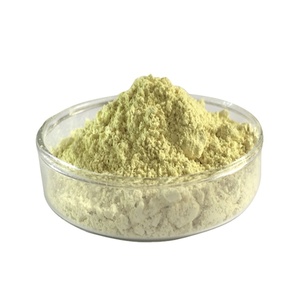
Quercetin Dihydrate is a natural pentahydroxyflavone obtained primarily through the precise acid-catalyzed or enzymatic cleavage of rhamnoglucoside bonds in Rutin, extracted from the unexpanded floral buds of Sophora japonica L. (Styphnolobium japonicum). Our process yields an ultra-fine, crystalline yellow powder standardized to ≥95.0% and ≥98.0% active quercetin dihydrate by validated reverse-phase High-Performance Liquid Chromatography (RP-HPLC).
HPLC Validated PurityUnlike hygroscopic anhydrous quercetin, the dihydrate form incorporates two stoichiometric water molecules into its monoclinic crystal lattice (molecular weight 338.27 g/mol). This configuration delivers superior thermodynamic equilibrium, reduced caking propensity under continental storage variations, and predictable thermodynamic dissolution kinetics when formulating tablets, hard capsules, and suspension matrices in variable relative humidity conditions.
Monoclinic StabilityOur quercetin dihydrate production lines adhere completely to both European Pharmacopoeia (Ph. Eur.) and United States Pharmacopeia (USP) monographs. Each batch is assayed to confirm the strictly controlled Loss on Drying (LOD) parameter (9.5% – 12.5%, matching theoretical 2H2O hydration), with sulfated ash ≤ 0.1%, residual ethanol < 5,000 ppm (Class 3 solvent), and zero detectable traces of chlorinated reaction catalysts or synthetic colorants.
USP / Ph. Eur. CompliantAligning raw botanical API delivery with the Republic of Uzbekistan’s national import substitution mandate, State Pharmacopoeia harmonization, and emerging clinical therapeutic pipelines.
Under presidential decrees focused on accelerating the development of the domestic pharmaceutical industry, the Republic of Uzbekistan has prioritized localized manufacturing of vital cardiovascular, angioprotective, and metabolic medicines. Domestic formulation leaders in the Tashkent, Samarkand, and Fergana pharmaceutical clusters are shifting rapidly away from expensive Western European finished dosed units toward purchasing standardized, active bulk ingredients (APIs). Our Quercetin Dihydrate powder equips Uzbek drug plants with an import-compliant, cost-competitive core material that seamlessly registers under the State Centre for Expert Examination and Standardization of Medicines, Medical Devices and Medical Equipment (Dori Vositalari Davlat Markazi).
Localized Production FocusAcross Central Asia, and notably within the Uzbek clinical sphere, bioflavonoids maintain enduring medical authority for their P-vitamin activity, endothelial protective capacity, and microvascular permeability mitigation. Historically anchored by traditional formulations like Ascorutin (Ascorbic Acid + Rutin), the modern Uzbek medical sector is transitioning to direct Quercetin therapy for accelerated bio-efficacy. High-potency Quercetin Dihydrate acts as a frontline antioxidant and capillary-stabilizing agent, essential in clinical therapies targeting chronic venous insufficiency, diabetic microangiopathy, hypertensive vascular damage, and post-viral pulmonary rehabilitation protocols widely prescribed across Uzbek state and private polyclinics.
Clinical Microvascular EfficacyUzbekistan experiences extreme continental climatic realities characterized by arid, dust-heavy summers and sharp winter freeze cycles. These environmental stressors correlate clinically with heightened allergic rhinitis, upper respiratory inflammations, and environmental oxidative stress across urban centers like Tashkent and industrial hubs like Navoi. Quercetin Dihydrate is a documented natural mast cell stabilizer, inhibiting histamine release and downregulating pro-inflammatory interleukins (IL-6, TNF-alpha). Uzbek nutraceutical brands capitalize on our micronized 80-mesh powder to manufacture specialized respiratory defense capsules, allergy-relief effervescent powders, and seasonal immune support syrups.
Respiratory & Anti-Histamine ActionWith consumer consciousness around Halal-certified ingredients serving as an indispensable baseline across Uzbekistan and neighboring Central Asian states, our Quercetin Dihydrate powder is manufactured in certified facilities strictly devoid of porcine processing aids, animal gelatin, or unapproved fermentation matrices. In the burgeoning functional food and dairy sector—such as fortified juices, green teas, and health waters formulated in Samarkand—our water-dispersible and micronized grades afford high-clarity blending capabilities without precipitation or off-flavors, satisfying both religious purity and sensory consumer expectations.
100% Halal VerifiedStandardized against international pharmacopoeial limits (USP / Ph. Eur.) and validated for immediate registration filing with Uzbek regulatory authorities.
| Analytical Parameter | Pharmacopoeial Reference Limit | SV Botanica Release Standard | Analytical Test Methodology |
|---|---|---|---|
| Physical Appearance | Yellow to greenish-yellow crystalline powder | Conforms; odorless, mild characteristic bitter taste | Visual / Organoleptic Inspection |
| Active Assay Content (C15H10O7) | ≥ 95.0% (Anhydrous basis) | ≥ 98.0% (Ph. Eur. / USP Grade) | RP-HPLC vs. Reference Standard |
| Loss on Drying (LOD) | 9.5% – 12.5% | 10.0% – 11.8% (Matches stoichiometric 2H2O) | Thermogravimetric Gravimetry (105°C, 3h) |
| Particle Size Distribution | N/A (Standard) | 100% through 80 mesh (Micronized: ≤ 20 μm option) | Analytical Sieve Sizing / Malvern Laser |
| Residue on Ignition (Sulfated Ash) | ≤ 0.1% | ≤ 0.05% | High-Temperature Muffle Furnace (600°C) |
| Heavy Metals Total (Pb, Cd, Hg, As) | ≤ 10.0 ppm | ≤ 2.0 ppm Total (Individual metals ≤ 0.5 ppm) | Inductively Coupled Plasma MS (ICP-MS) |
| Residual Solvents | Ethanol ≤ 5,000 ppm; Methanol ≤ 3,000 ppm | Ethanol ≤ 1,000 ppm; Methanol Not Detected | Headspace Gas Chromatography (GC-MS/FID) |
| Total Aerobic Microbial Count (TAMC) | ≤ 1,000 CFU/g | ≤ 100 CFU/g | Membrane Filtration / Plate Incubation |
| Yeast and Molds (TYMC) | ≤ 100 CFU/g | ≤ 20 CFU/g | Ph. Eur. 2.6.12 Microbial Limit Testing |
| Pathogenic Bacteria (E. coli, Salmonella) | Negative in 25g | Absent / Negative per 25g | Selective Chromogenic Enrichment |
Overcoming Biopharmaceutics Classification System (BCS) Class IV solubility and permeability constraints in pharmaceutical manufacturing facilities.
Quercetin dihydrate features needle-like crystalline habits that require optimized excipient selection to guarantee uniform dies filling, tablet hardness, and dissolution rates. We supply an agglomerated 80-mesh powder engineered with superior bulk density (0.40 – 0.60 g/mL) for direct blending with Microcrystalline Cellulose (MCC PH-102), colloidal silicon dioxide, and superdisintegrants (Croscarmellose Sodium), preventing segregation during high-speed rotary press cycles in local pharmaceutical plants.
Direct Compression GradeBecause quercetin displays inherent lipophilicity and poor aqueous solubility, cutting-edge Uzbek R&D laboratories are integrating phospholipid complexation technology. By complexing our ultra-pure Quercetin Dihydrate with standardized non-GMO soy or sunflower lecithin in a 1:1 or 1:2 stoichiometric molar ratio, formulators create quercetin phytosomes that demonstrate up to 20-fold increases in human plasma area-under-the-curve (AUC) bioavailability without gastric irritation.
Advanced BioavailabilityIn response to growing Central Asian consumer demand for OTC dynamic drink mixes, our micronized quercetin powders (≤ 20 microns) integrate seamlessly into effervescent platforms. Formulated alongside ascorbic acid, zinc citrate, sodium bicarbonate, and citric acid, our material achieves rapid, homogeneous suspension without forming hydrophobic surface rings or oily scum, providing immediate therapeutic delivery during acute cold seasons.
Aqueous Dispersion TechDirect supply chain management connecting production facilities to customs clearance terminals across Tashkent, Sergeli, and Samarkand.
We provide stable freight routes designed for bulk active botanical ingredients. Utilizing maritime shipping from Mumbai (Nhava Sheva/JNPT) to Bandar Abbas port in Iran, shipments connect directly via international rail through Sarakhs (Turkmenistan border) straight to Tashkent Chukursay rail freight terminal. Transit duration averages 18 to 22 calendar days. For critical sample validation or immediate batch needs, expedited air freight directly into Islam Karimov Tashkent International Airport (TAS) provides a 4-to-6 day customs-dock release.
Optimized INSTC CorridorClearing customs and securing state registration under the Ministry of Health of Uzbekistan requires thorough documentation. Every consignment is dispatched with a comprehensive dossier: Original Certificate of Analysis (identifying HPLC assay method), Detailed Technical Data Sheet (TDS), Safety Data Sheet (SDS/MSDS according to GHS), Non-GMO Statement, Allergen Declaration, ETO-Free Certification, Halal Certificate, and legalized Certificate of Origin (Form A / General). Our regulatory unit works directly with your local brokers to ensure zero delays at customs checkpoints.
Full Dossier SupportPartnering with a globally verified B2B exporter of 150+ standardized botanical extracts, oleoresins, and active pharmaceutical raw materials.
Extracted and refined in state-of-the-art facilities compliant with Current Good Manufacturing Practices (cGMP), ISO 9001:2015, and ISO 22000, ensuring absolute batch-to-batch homogeneity.
Audited ProductionEvery lot undergoes identity checks via Thin-Layer Chromatography (TLC), HPLC purity profiling, and elemental contamination testing via Agilent ICP-MS instruments before dispatch.
Zero ContaminationDirect supply agreements with audited botanical growing regions guarantee fresh, high-rutin content raw flower buds with complete pesticide residue auditing below strict EU MRL limits.
Traceable OriginsOur regulatory pharmacists and analytical chemists respond to specification inquiries, method validation queries, and technical documentation needs within one business day.
Rapid Scientific ServiceDirect technical answers addressing the operational, analytical, customs, and stability requirements of buyers in the Republic of Uzbekistan.
We test and release our Quercetin Dihydrate powder exclusively using validated reverse-phase High-Performance Liquid Chromatography (RP-HPLC) measured against a certified USP or Ph. Eur. reference standard. Many bulk commodity suppliers quote ≥95% or ≥98% calculated via UV-Visible Spectrophotometry. Spectrophotometric assays systematically overestimate active bioflavonoid purity by reading other related flavonols (such as isorhamnetin and kaempferol) at the same absorption wavelength (approx. 370 nm). We explicitly detail the exact HPLC column, mobile phase parameters, flow rate, and retention times on our Certificate of Analysis so that incoming QC laboratories at Uzbek manufacturing facilities reproduce identical assay values upon factory arrival.
Quercetin Dihydrate features two structurally integrated water molecules in its crystalline lattice, imparting superior thermodynamic stability compared to the hygroscopic anhydrous variant. In regions like Tashkent, Samarkand, and the Fergana Valley, where indoor warehouse ambient temperatures fluctuate between freezing winter cold and summer highs exceeding 42°C, anhydrous quercetin readily absorbs ambient atmospheric moisture, resulting in agglomeration, crystal clumping, and altered tableting compressibility. Our dihydrate form remains structurally constant at 10.0% – 11.5% Loss on Drying. When packed in our export-grade double pharmaceutical-grade polyethylene interior bags encased within sealed high-density fiberboard drums with desiccants, stability remains confirmed across 24 to 36 months.
Yes. We regularly supply comprehensive raw material technical files to support local drug and dietary supplement registration with the State Centre for Expert Examination and Standardization of Medicines, Medical Devices and Medical Equipment under the Ministry of Health of the Republic of Uzbekistan. Our standard dossier package includes complete manufacturing flowcharts, validated extraction solvent declarations (verifying zero use of Class 1 toxic solvents), elemental impurity profiles per ICH Q3D guidelines, residual solvent gas chromatography profiles per USP <467>, TSE/BSE risk-free declarations, and 36-month real-time stability study summaries.
Our standard Minimum Order Quantity (MOQ) for commercial production lots of Quercetin Dihydrate is 25 kg (one standard export fiber drum). For pilot trial production, formulation R&D, or registration batch validation in Uzbekistan, we facilitate sample trial quantities of 1 kg to 5 kg sealed in multi-layer aluminum vacuum-barrier pouches. Standard commercial packaging features non-toxic, food-and-pharma certified double polyethylene liners hermetically heat-sealed inside sturdy 25 kg fiber drums with tamper-evident locking rings, optimized for palletized rail and road freight.
Yes. Our extraction and crystallization processes are fully certified Halal. The entire extraction pathway from Sophora japonica bud to final crystalline powder is purely botanical and mineral: ethanol-water extraction, mechanical filtration, dilute inorganic acid hydrolysis of rutin, water washing, centrifugation, and fluid-bed drying. No animal-derived enzymes, porcine processing aids, or synthetic alcohol denaturants are introduced at any point. Consignments destined for Uzbekistan are issued official Halal batch certificates acceptable to local religious and quality surveillance agencies.
We deploy high-sensitivity Inductively Coupled Plasma Mass Spectrometry (ICP-MS) to screen every production lot against international limits, guaranteeing: Lead (Pb) < 0.5 ppm, Arsenic (As) < 0.5 ppm, Cadmium (Cd) < 0.2 ppm, and Mercury (Hg) < 0.1 ppm. Total heavy metal burden is consistently below 2.0 ppm, outperforming the baseline European Pharmacopoeia and USP thresholds (≤ 10.0 ppm). This ensures that finished pharmaceutical solid dosages and dietary capsules formulated in Uzbekistan comfortably clear national sanitary-epidemiological toxicology thresholds.
Standard botanical powders often suffer from low bulk density and irregular crystal habit, causing friction and die-binding during direct tableting. We offer a specialized agglomerated 80-mesh powder with controlled bulk density (0.45 – 0.55 g/mL) and tapped density (> 0.60 g/mL), exhibiting superior flowability (Carr's Index < 20%). When blended with standard direct compression excipients like Microcrystalline Cellulose and magnesium stearate, our powder provides uniform die filling, prevents capping, and maintains high tensile tablet strength across presses exceeding 100,000 tablets per hour.
Our standard freight route utilizes maritime transport from Indian main ports (Nhava Sheva/JNPT or Mundra) to Bandar Abbas, Iran, followed by bonded rail transit along the International North-South Transport Corridor (INSTC) via Sarakhs into Uzbekistan, discharging at the Tashkent Chukursay rail freight terminal. Total door-to-terminal transit typically ranges between 18 and 22 calendar days. For urgent formulation requirements, air freight direct to Tashkent Airport (TAS) provides arrival within 4 to 6 business days.
No. We enforce a strict non-ETO and non-irradiation policy across all our botanical extracts. Microbial control is maintained exclusively through validated cleanroom extraction conditions, high-temperature short-time aqueous processing, and closed-loop sanitary fluid-bed drying. Every batch undergoes third-party GC-MS testing to confirm zero detectable ethylene oxide and 2-chloroethanol residues (below 0.01 ppm detection limits), guaranteeing complete regulatory compliance with both Uzbek and European food/pharma safety directives.
We work under standard Incoterms 2020, regularly handling CIP Tashkent (by rail or air freight), CIF Bandar Abbas, and FCA/FOB arrangements. For verified pharmaceutical manufacturers and long-term contract partners in Uzbekistan, we support secure international payment modalities including confirmed, irrevocable Letters of Credit (L/C) at sight, as well as telegraphic transfer (T/T) structures tied to pre-shipment sample laboratory release.
Direct manufacturer supply, full batch Certificates of Analysis, pre-shipment pilot samples, and complete regulatory support for pharmaceutical and dietary supplement enterprises throughout Uzbekistan.